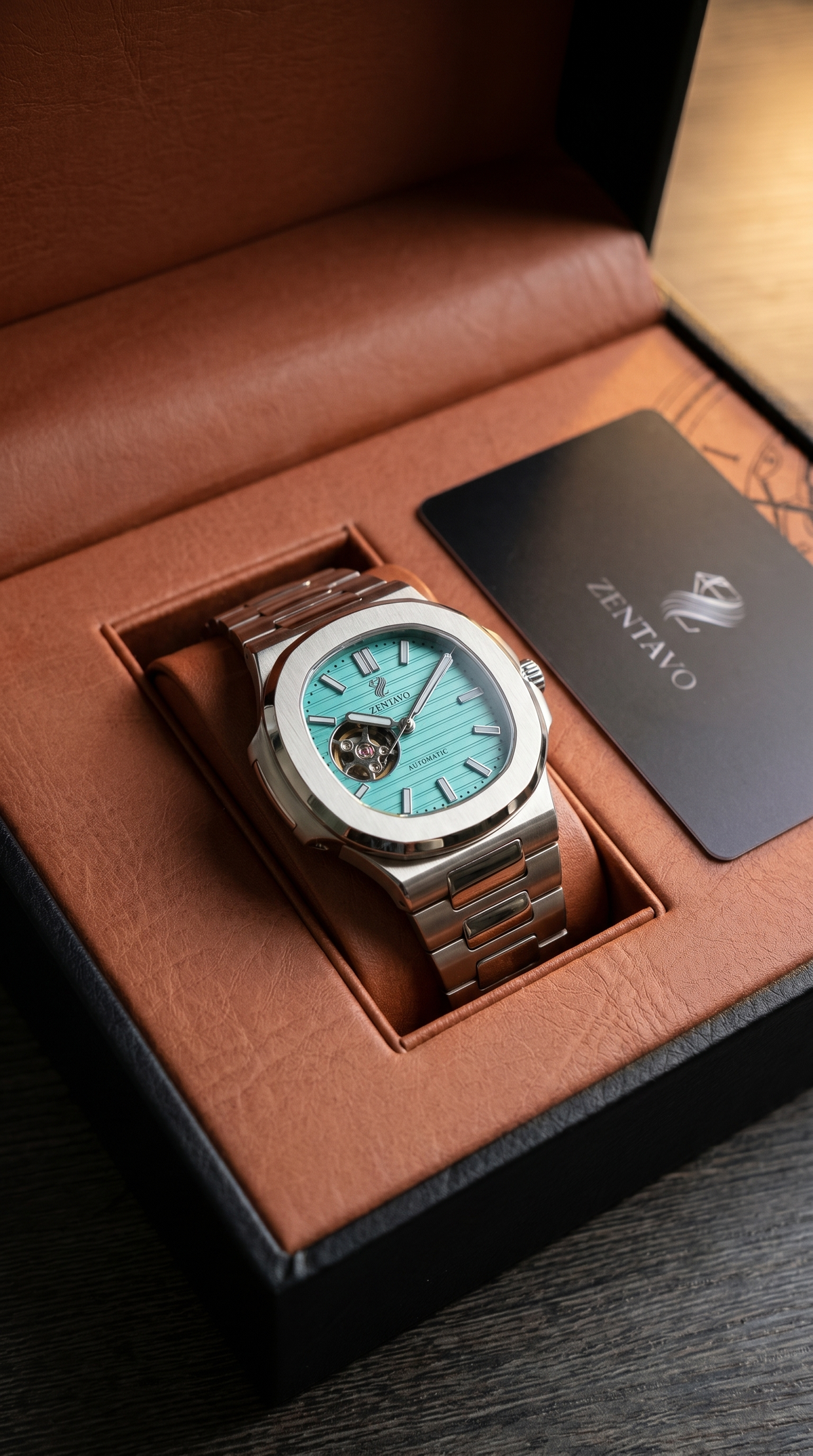

An automatic watch runs on the motion of your wrist: a weighted rotor swings as you move, winds a spring, and that spring releases its energy step by step through a gear train to a balance wheel that swings back and forth at a fixed rhythm. In the Zentavo movement, the NH38A, that balance beats 21,600 times per hour — six beats per second — and there is no battery anywhere.
The short version: four parts
Every automatic movement, from an entry-level calibre to haute horlogerie, is built from the same four parts. Know these four and you know what happens under the dial:
- The rotor — a half-moon weight that spins when you move your arm and winds the spring.
- The mainspring — a coiled steel ribbon in a barrel that stores the energy.
- The gear train and escapement — which divide that energy into small, equal portions.
- The balance wheel — the oscillating wheel that sets the rhythm. This is the heart of the watch.
Below, we follow the energy from your wrist to the seconds hand.
1. The rotor: winding by moving
Turn an automatic watch over (with an open caseback) and you see a weight that can spin freely. Gravity keeps the weight 'hanging' while your wrist moves, so it rotates relative to the movement. That rotation runs through a series of small gears to the mainspring and tightens it a little each time.
A single arm movement adds very little; the gearing is designed so that many small movements add up. An ordinary day on the wrist — walking, typing, driving — keeps the spring well wound. You can also wind the movement by hand through the crown, which is useful when the watch has been lying still (more in our guide to power reserve and winding).
2. The mainspring: the energy store
The mainspring sits coiled inside a small drum called the barrel. The more the rotor turns, the tighter the spring becomes. Because an automatic is wound all day long, the movement has a safeguard: a slipping bridle lets the spring slide at the end of the barrel once it is full. Overwinding is therefore impossible, whether by rotor or by crown.
The spring wants to unwind as fast as it can. Left free, it would release all its energy in a fraction of a second. The rest of the movement exists to let that energy out in a controlled, even way.
3. Gear train and escapement: energy in portions
From the barrel, the force travels through the gear train: a sequence of wheels that converts the motion into the speed of the hour, minute and seconds hands. At the end of that chain sits the key mechanism: the escapement.
The escapement consists of an escape wheel and a pallet fork. The pallet fork locks the escape wheel for a brief moment, then lets it advance by one tooth. With every release the balance gets a small push, just enough to keep it swinging. The audible tick of a mechanical watch is exactly this: the pallet fork locking and releasing the escape wheel.
4. The balance wheel: a heart you can see
The balance is a small wheel with a hair-thin spiral spring. It swings back and forth at a fixed rhythm, and that rhythm decides how fast the hands turn. In the NH38A this happens 21,600 times per hour, or six beats per second. That is why the seconds hand of an automatic seems to glide: it takes six small steps per second instead of one big jump.
At Zentavo this heart is not hidden. The dial has an open window between 8 and 10 o'clock, right above the balance, so you can watch it swing in real time. What that window is and where the name comes from: what is a skeleton watch.
5. What does '24 jewels' mean?
Many movements list a number of 'jewels'. They are not decorative stones but small synthetic rubies used as bearings where axles turn and friction occurs. Ruby is hard and smooth, so the pivots wear less and the oil keeps working longer. The NH38A has 24 of them — ruby bearings, not ornaments.
Automatic, hand-wound or quartz: the difference
| Automatic | Hand-wound | Quartz | |
|---|---|---|---|
| Energy source | rotor + mainspring, wound by motion | mainspring, wound by the crown | battery |
| Rhythm | balance wheel (NH38A: 21,600 beats/h) | balance wheel | quartz crystal |
| Seconds hand | glides in small steps | glides in small steps | jumps once per second |
| Battery change | never | never | every few years |
| What you see | a mechanism in motion | a mechanism in motion | usually nothing |
Quartz is more accurate and cheaper; an automatic is a mechanism you wear, one that keeps running without a battery as long as you use it. The full trade-off is in automatic vs quartz watches.
The Zentavo movement in numbers
| Part | Specification |
|---|---|
| Movement | NH38A, automatic (self-winding), can also be wound by hand |
| Frequency | 21,600 beats per hour (6 per second) |
| Bearings | 24 jewels |
| Crystal | sapphire, anti-reflective |
| Case | 42 mm, 316L steel |
| Water resistance | 3 ATM (30 m): splashes and rain, not swimming |
| Warranty | 1 year |
| Battery | none |
Every component was chosen personally by the founder, with one criterion: a movement you can see working that lasts for years. All seven finishes share the same movement; see them in the collection or take the Onyx as an example.
What this means when you wear one
If you wear the watch every day, there is nothing to do: your wrist keeps it going. Put it away for a few days and the spring runs down and the watch stops. That is normal and does no harm to the movement. Winding it with the crown and setting the time is all it takes to start it again.
A mechanical movement deviates a little more than quartz; you measure that in seconds per day, not per month. How to keep the movement healthy (avoid magnetism and shocks, plan a service now and then) is covered in how to care for an automatic watch.
Frequently asked questions
Does an automatic watch need a battery?
No. The energy comes from a mainspring wound by the rotor as you move your wrist, or by hand through the crown. There is no battery inside.
Can I overwind an automatic watch?
No. A slipping bridle lets the mainspring slide once it is fully wound, whether the winding comes from the rotor or from the crown.
Does an automatic watch stop when I take it off?
Not immediately. It keeps running on the energy stored in the mainspring and stops only when that runs out. Wind it with the crown and set the time to start it again.
Why does the seconds hand glide instead of tick?
The NH38A balance beats 21,600 times per hour. That is six small steps per second, so the hand appears to move smoothly.
What are the 24 jewels in the movement?
Synthetic rubies used as bearings for the pivots. They reduce friction and wear. They are not decorative stones.